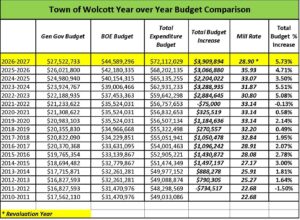
The Wolcott Republican Town Committee is deeply disappointed by the recent Town Council vote adopting a budget that increases town spending by nearly $4 million and establishes a new mill rate of 28.90 following a revaluation that substantially increased many property assessments.
The Wolcott Republican Town Committee commends Republican Council members Terri Sheehan, Anthony Guerrera, Cory Lagasse, and Rachel Wisler for voting no and supporting an effort to limit the size of this spending increase. The five members of the Town Council who voted yes should be prepared to explain why even a modest effort to restrain the increase was unacceptable and why Wolcott residents should bear the additional financial burden.
Since FY 2021-22, Wolcott’s total adopted budget has grown from $56,757,653 to $72,112,029 an increase of more than $15.3 million, or approximately 27%, in only a few budget cycles.
During that same period, General Government spending increased by nearly 30%, while Board of Education spending increased by more than 25%.
Wolcott has long been known as a community where seniors, homeowners, working families, and small businesses could depend on reasonable taxes and responsible local government. Many residents chose to live here for precisely that reason.
Unfortunately, this budget moves Wolcott in the wrong direction.
Affordability must be a central priority at every level of government. Wolcott residents are struggling with higher electric bills, groceries, housing costs, insurance premiums, medical expenses, and nearly every other cost of daily life.
Government should not add to that burden unless every reasonable effort has first been made to control spending.
The adopted budget accepts the proposed spending levels without meaningful reductions. The four Republican members of the Town Council who remain committed to the principles endorsed by Wolcott voters voted no and supported reducing the overall increase by $1 million.
Even under that proposal, town spending still would have increased by approximately $3 million.
That was not a proposal to cut existing spending. It was an effort to limit the size of a substantial increase.
Wolcott voters elected six Republicans by overwhelming margins because they expected a Republican majority to advance responsible budgeting, fiscal restraint, and protection for taxpayers. The three Democratic members hold seats because state law guarantees minority-party representation, not because Wolcott voters chose Democratic control of the council.
Nevertheless, two council members elected and endorsed as Republicans joined with all three Democrats to determine council leadership over the objections of four of the six elected Republicans.
Now, that same five-member coalition has approved what is, in substance, a Democratic town budget, adopting the full proposed spending increase and rejecting even a modest effort to reduce the burden on taxpayers.
The Wolcott Republican Town Committee considers this a continuing betrayal of the responsibility those councilors accepted when they sought office as endorsed Republican candidates. They were elected as part of a Republican majority entrusted to protect taxpayers, not to transfer effective control to a Democratic minority and enact its spending priorities.
Those five members approved this budget and the tax burden that comes with it. They should explain why a nearly $4 million increase was necessary, why an approximately $3 million increase was insufficient, and why more could not be done to protect taxpayers.
We also want to be clear: education, public safety, essential town services, and the employees who provide them are important to our entire community. The issue is not whether our school’s matter. Of course they do.
But support for education should not require the dismissal of every other concern raised by taxpayers. Declaring one priority morally beyond question may be politically convenient, but responsible governing requires recognizing that a town cannot spend without limit, tax without consequence, or elevate one constituency while ignoring residents who are struggling to remain in their homes.
The question is whether elected officials have adequately explained why spending has increased by more than 25% since FY 2021-22, what efforts were made to control costs, and why taxpayers should absorb those increases while many households are already under significant financial strain.
Taxpayers deserve specific answers.
What changed sufficiently to require millions of dollars in additional spending? Which costs are imposed by the state? Which result from contractual obligations? Which are discretionary? What savings were seriously considered? Why was even a $1 million reduction in the proposed increase rejected?
A major part of the problem is that local budgets are increasingly driven by costs built into the system before taxpayers ever see the final bill. Contractual wage increases, employee benefits, binding arbitration, state mandates, special education requirements, and other obligations imposed or heavily influenced by state law place enormous pressure on municipal and education budgets.
Binding arbitration allows labor disputes to be decided by outside arbitrators who can impose contract terms on municipalities. Local officials and taxpayers are then responsible for funding costs they did not directly approve.
Public-sector contracts also commonly include scheduled wage increases and benefit obligations that must be funded regardless of the financial circumstances confronting individual taxpayers.
Many Wolcott residents work in the private sector or live on fixed incomes. Some receive regular raises, while others do not. Some have seen their wages increase, while others have fallen behind the rising cost of living. When their expenses exceed their income, they must reduce spending, postpone purchases, work longer hours, or do more with less.
Residents can decide for themselves how those experiences compare with compensation structures funded through their property taxes. That comparison is not an attack on any individual employee or a judgment about what anyone deserves to earn. It is a legitimate question about whether the system fairly balances contractual obligations with the ability of taxpayers to pay.
Taxpayers are entitled to ask why government should be exempt from the same financial discipline expected of the people paying for it.
Many of these pressures originate in Hartford.
Democrats controlling state government have repeatedly defended binding arbitration, imposed unfunded mandates, expanded state requirements, and transferred additional costs onto municipalities and local property taxpayers.
Wolcott’s Republican representatives in the State Legislature have fought those policies while supporting reforms to binding arbitration, reductions in unfunded mandates, greater local control, lower energy costs, increased municipal and education aid for Wolcott, and an end to the transfer of state costs onto local property taxpayers.
Unfortunately, many of those efforts have been blocked by the Democratic majority and by a governor who continues to support policies that make Connecticut and its municipalities less affordable.
State policies make responsible local budgeting more difficult, but they do not eliminate the responsibility of local officials to defend taxpayers. Local officials should demand reform, scrutinize every dollar, and make affordability a central consideration. They should not simply pass the entire burden down to residents.
Supporters of the budget may point out that the mill rate has declined. That does not tell the full story.
Revaluation substantially increased assessed values for many homeowners. When assessments rise, the mill rate can decline while individual tax bills still increase. What matters is not whether the mill rate went down on paper. What matters is how much residents will actually be required to pay.
When residents receive their new tax bills, they will see the real impact. Many will be shocked. Many will be angry. Some will be furious.
Every elected official has an obligation to represent the entire community taxpayers, seniors, homeowners, business owners, municipal employees, parents, students, and every other Wolcott resident. No single constituency should dominate the budget process while those responsible for paying the bill are expected simply to accept the outcome.
We believe Wolcott taxpayers deserved a better result.
The Wolcott Republican Town Committee will continue advocating for responsible budgeting, reasonable taxes, accountable government, and an economic environment in which residents can afford to remain in the community they call home.
Wolcott deserves a government that treats affordability as a priority, not an afterthought.